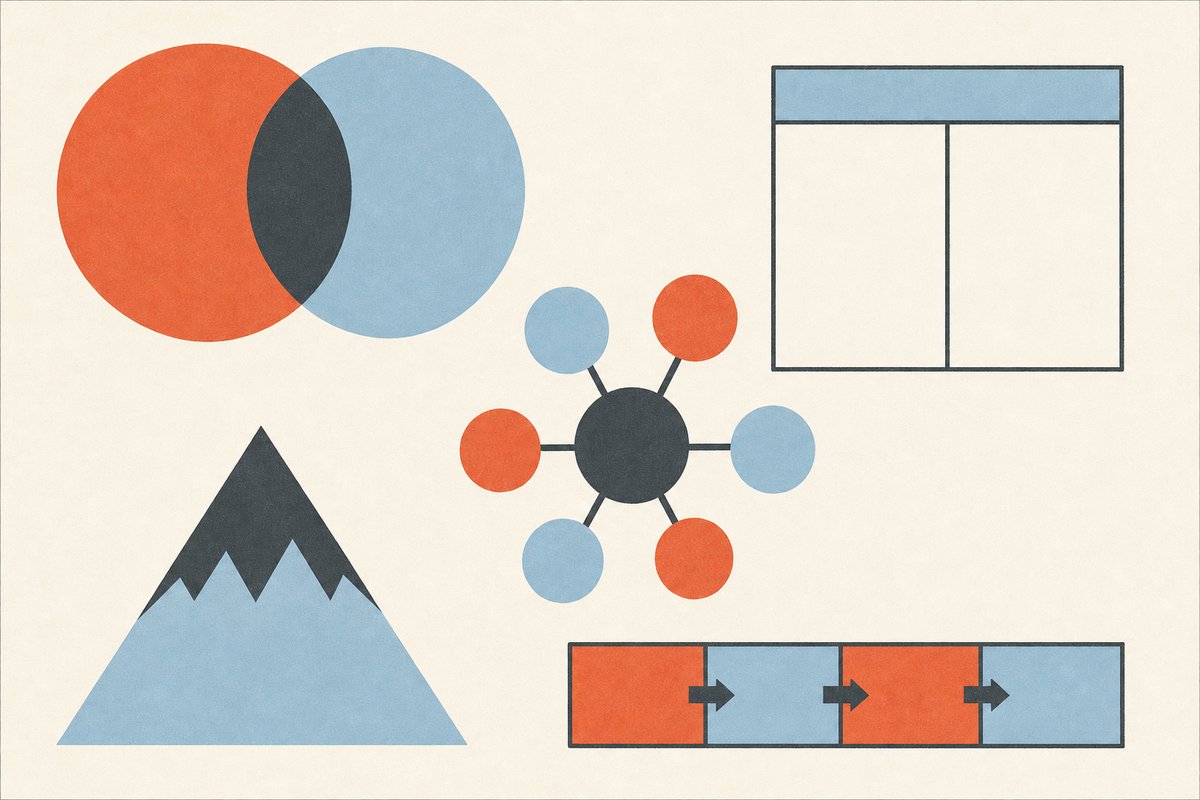
A graphic organizer is the quiet workhorse of the English Language Arts classroom. Ask students to compare two characters, plan an essay, or untangle a confusing chapter, and the right visual framework can turn a stuck stare into productive thinking. This guide explains what graphic organizers are, why they work, and — most usefully — which one to reach for depending on the task in front of your students, with links to ready-to-print templates.
What is a graphic organizer?
A graphic organizer is a visual framework that arranges information so its structure becomes visible. A chart, a web, a grid, a diagram — each lays out ideas in space so that relationships among them stand out: what is similar, what is different, what comes first, what causes what. Instead of describing a relationship in a sentence, the organizer shows it.
That is the whole idea in a single move. By giving ideas a place to sit, a graphic organizer lets a reader or writer see the shape of their thinking — and once thinking has a shape, it can be questioned, revised, and shared.
Why graphic organizers work
Three things explain why graphic organizers earn their place in so many lessons:
- They reduce cognitive load. Holding a whole story or argument in working memory is hard. An organizer offloads that information onto the page, freeing mental room for the actual thinking — analyzing, comparing, evaluating.
- They make thinking visible. A filled-in organizer is a window into a student’s reasoning. Teachers can spot a gap or a misconception at a glance, and students can give one another feedback on something concrete.
- They scaffold independence. A reusable structure that a student practices with the class can later be used alone, on a new text. Over time the scaffold can be removed entirely.
These benefits are strongest for striving readers and for multilingual learners, who gain the most when an abstract idea is anchored to a concrete, repeatable picture. Literacy research has long associated graphic organizers with better comprehension and retention — provided students are taught not just how to fill one in, but when each kind is the right choice.
It also helps to think about timing. The same organizer can do different work depending on when it appears in a lesson. Before reading or writing, an organizer activates prior knowledge and sets a purpose — a KWL chart or a quick brainstorming web primes students for what is coming. During reading, an organizer becomes a live note-taking tool: students fill in a story map or a character map as events unfold, which keeps them tracking structure instead of drifting. After reading, an organizer supports synthesis and review — summarizing, comparing, or analyzing what was read. One framework, three jobs, depending on where it sits in the arc of the lesson.
Organizers for understanding reading
Reading organizers help students see the architecture of a text. The essentials:
- Plot diagram. Maps a narrative onto the rising-and-falling arc of exposition, rising action, climax, falling action, and resolution. It is the go-to tool for narrative structure — see the full guide to the plot diagram.
- Story map. A close cousin of the plot diagram that lists the key narrative elements — characters, setting, problem, events, resolution — rather than drawing the arc. Great for younger or striving readers.
- Character map. Records a character’s traits, motivations, relationships, and changes over a story. It pairs naturally with a study of the different character types.
- Story-elements chart. Captures the building blocks of a narrative in one frame — setting, character, plot, conflict, and theme. It is the foundation for summarizing and analyzing conflict.
- Main idea and details. Separates the central point of a passage from the supporting evidence — essential for informational text.
- Sequence chart. Orders events or steps, useful for both narrative and procedural text.
These reading organizers are not isolated tools; they form a small family that builds on itself. A story map and a plot diagram describe the same narrative from two angles — one lists the parts, the other draws their rising-and-falling shape — so students who outgrow the list can graduate to the arc. A character map deepens the same study by asking who the events happen to, which is exactly where an understanding of the types of characters pays off. And a story-elements chart sits underneath all of them, naming the setting, conflict, and theme that the other organizers assume. Introduced in that order — elements first, then structure, then character — the organizers reinforce one another instead of competing for attention, and students start to see a story as a system of related parts rather than a single confusing whole.
Organizers for planning writing
Before a student writes, an organizer helps them gather and arrange ideas so the draft has a backbone:
- Beginning-middle-end / narrative organizer. Plans a story’s structure before drafting — the writing-side mirror of the plot diagram.
- Opinion and argument organizers. Separate the claim from the reasons and evidence, and prompt students to address a counterargument.
- Compare and contrast (Venn diagram). Two or more overlapping circles for similarities and differences — perfect for comparing characters, texts, or ideas.
- Cause and effect. Links an event to its consequences, supporting explanatory writing and deeper reading alike.
- Problem and solution. Frames an issue and the proposed responses to it.
- Somebody-Wanted-But-So-Then. A compact frame — character, goal, conflict, outcome — that doubles as the most reliable summarizing tool in the room.
Organizers for building vocabulary
Vocabulary organizers push past a one-line definition toward real word knowledge:
- Frayer model. A four-box frame — definition, characteristics, examples, non-examples — around a target word. The non-examples box is what makes it powerful.
- Word web. A central word surrounded by synonyms, related words, and forms, building networks rather than isolated entries.
- KWL chart. Know / Want to know / Learned — equal parts vocabulary, comprehension, and metacognition.
- Concept map. Connects a network of related terms to show how a whole topic fits together.
How to choose the right one
The single most useful habit is to start from the purpose, not the worksheet. Name the thinking you want students to do, then pick the organizer whose shape matches that relationship. The map below sorts the most-used organizers by classroom purpose.
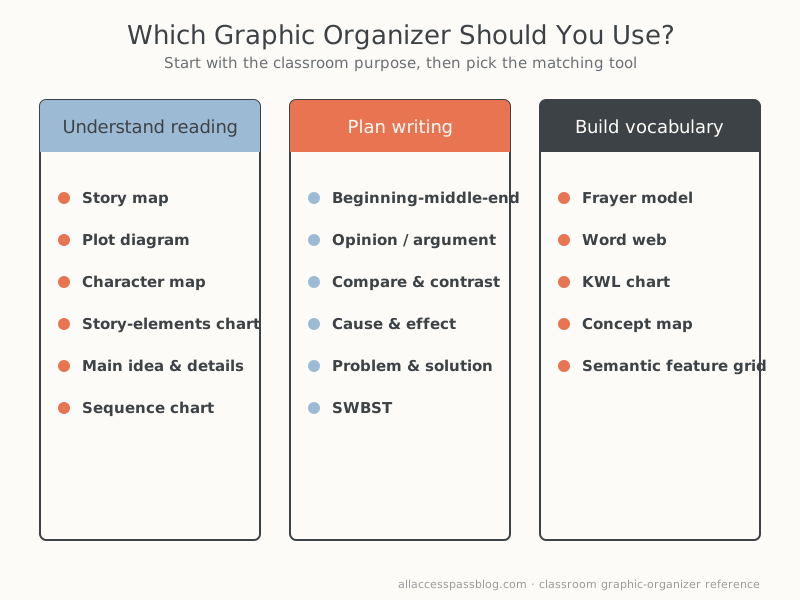
Embed this infographic (copy and paste the code):
A quick reference for the most common decisions:
| If students need to… | Reach for… |
|---|---|
| Track a story’s structure | Plot diagram or story map |
| Compare two things | Venn diagram |
| Summarize a narrative | Somebody-Wanted-But-So-Then |
| Analyze a character | Character map |
| Learn a key word deeply | Frayer model |
| Plan a persuasive essay | Opinion / argument organizer |
| Activate prior knowledge | KWL chart |
A simple routine for using them well
A graphic organizer only helps when students understand the thinking behind it. Handed out cold, it becomes a fill-in-the-blank chore; introduced with care, it becomes a tool students reach for on their own. A reliable routine follows the gradual-release model — modeled, then guided, then independent practice:
- Model it. Think aloud while filling in the organizer with a short, familiar text on the board. Make the decisions visible — why this event is rising action, why these two traits belong in the overlap of a Venn diagram. Students see not just the finished chart but the reasoning that produced it.
- Practice together. Work through a second example as a class, inviting students to supply the entries. This is where misconceptions surface and get corrected in low-stakes conversation, before any grade is attached.
- Release it. Hand out a blank template and let students complete it with a new text, first in pairs and then alone. The goal is for the scaffold to fade until students no longer need the printed boxes at all — they have internalized the structure.
A few common mistakes are worth heading off. The first is treating the organizer as the destination rather than a step toward reading, discussion, or writing — a completed chart is a means, not the end product. The second is using the same organizer for everything; when every task gets a web, the shape stops carrying meaning. The third is skipping the modeling and assuming students know how to use a tool just because it looks simple. And the fourth is leaving no room for revision: thinking changes as students read, so the boxes should be editable, not final on first pass.
Used this way, a graphic organizer is less a worksheet than a rehearsal space — somewhere students try out an idea, see it laid bare, and adjust before committing it to a paragraph or an argument.
Print or digital?
Both formats work, and the right choice depends on the goal rather than the technology. Printed organizers are fast to deploy, easy to annotate by hand, and free of screen distractions — handwriting also slows students down in a way that can deepen processing. They shine for in-the-moment note-taking during reading and for younger students still building fine-motor and layout habits. Digital organizers, by contrast, are effortless to revise, simple to share for collaboration or feedback, and easy to project for whole-class modeling. A practical compromise many teachers settle on is to model digitally on a projector, then hand out a printable template for independent practice — pairing the visibility of the screen with the focus of paper. Whichever format is used, the principles are the same: match the organizer to the purpose, model it before assigning it, and treat the entries as revisable thinking rather than final answers.
Free printables and where to go next
The organizers above are most useful when they are one click from the lesson. The in-depth guides on this site pair each concept with a printable template and a worked example:
- The plot diagram — a labeled diagram, a blank template, and a worked example from a classic short story.
- Teaching character types — the complexity-and-change framework, plus a character map.
- Story elements and conflict — the building blocks of narrative and the Somebody-Wanted-But-So-Then summary frame.
Start from the purpose, choose the matching organizer, model it once with the whole class, and then hand students the template and step back. That sequence — name the thinking, show the structure, release responsibility — is what turns a graphic organizer from a worksheet into a habit of mind.