
The plot diagram is one of the most useful tools in the English Language Arts classroom. It takes something abstract — the shape of a story — and turns it into a picture students can point to. Once a reader can see where the tension rises, where it peaks, and where it settles, comprehension stops being guesswork. This guide explains what a plot diagram is, where it comes from, the five parts it maps, and how to teach it, and it includes a labeled infographic and a free printable template.
What is a plot diagram?
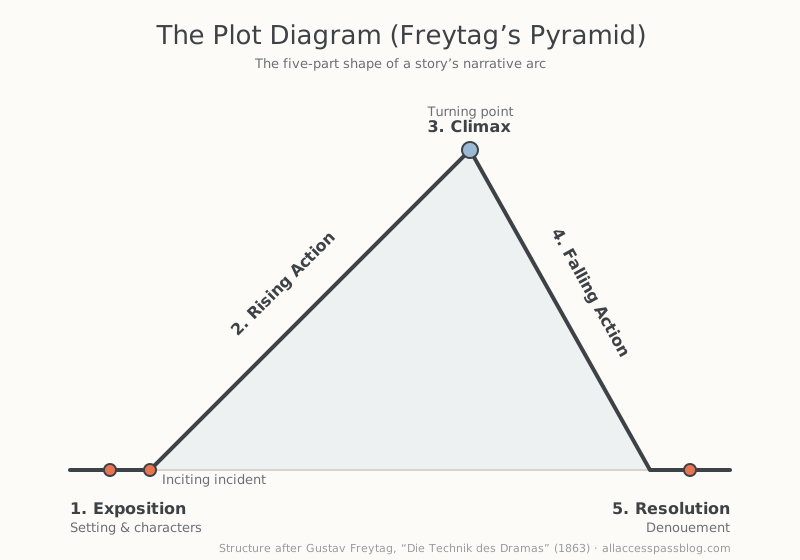
A plot diagram is a graphic organizer that maps the events of a narrative onto a triangular, mountain-like shape. The horizontal axis represents time — the order in which events happen — and the vertical axis represents tension, or how much is at stake for the characters. As a story builds toward its turning point, the line climbs; after the turning point, it descends toward an ending.
That single picture does a lot of work. It shows that stories are not flat lists of events but structured experiences with a beginning, a middle that intensifies, and an end that releases. For developing readers, drawing the diagram is often the moment plot structure finally clicks. It is also a natural companion to other reading tools, including the different character types who drive the action and the larger family of graphic organizers for the ELA classroom.
There is a good reason the plot diagram has stayed in classrooms for so long: it externalizes thinking. Reading comprehension research has long pointed to “story grammar” — the idea that readers understand narratives better when they can identify the recurring structural roles every story shares. A plot diagram makes that grammar visible. Instead of holding the whole shape of a story in working memory, students offload it onto the page, where it can be discussed, revised, and compared. That is especially valuable for striving readers and for multilingual learners, who benefit when an abstract idea is anchored to a concrete, reusable picture.
Where it comes from: Freytag’s Pyramid
The diagram’s shape is usually credited to Gustav Freytag (1816–1895), a German novelist and critic. In his 1863 book Die Technik des Dramas (“The Technique of the Drama”), Freytag analyzed the structure of classical and Shakespearean tragedy and described its action as a rising and falling pattern. Diagrammed, that pattern looks like a pyramid — which is why the plot diagram is often called Freytag’s Pyramid.
Freytag’s original model had five stages built around a central climax. Modern classroom versions keep that five-part spine but simplify the vocabulary and add the inciting incident as a marked point, since naming the moment a story’s problem begins helps students find the rising action.
The five parts of a plot
Every plot diagram is built from the same five parts, in the same order. Here is what each one means, with a quick illustration.
1. Exposition
The exposition opens the story. It introduces the setting, the main characters, and the situation as it stands before any major problem appears — the “normal world.” In a fairy tale, the exposition is the once-upon-a-time: who lives where, and what their ordinary life is like.
Many teachers mark the inciting incident at the end of the exposition. This is the specific event — an invitation, an arrival, a discovery, a loss — that upsets the balance and sets everything in motion.
2. Rising action
The rising action is usually the longest stretch of a story. It is the chain of events and complications that follow the inciting incident as the main character pursues a goal or wrestles with a conflict. Each complication raises the stakes a little higher, and tension accumulates on the climb toward the peak. Strong rising action keeps readers asking, “What happens next?”
3. Climax
The climax is the turning point and the moment of greatest tension. It is where the central conflict comes to a head and the story’s outcome is decided. The climax is emotional as much as structural: it is the part students usually remember most vividly. Importantly, it is rarely the final event — there is still story left after it.
4. Falling action
The falling action covers what happens as a direct result of the climax. Consequences play out, secondary threads begin to close, and the story moves toward its ending. Falling action tends to move faster than rising action because the central question has already been answered — readers are now watching the dust settle.
5. Resolution (denouement)
The resolution, also called the denouement (a French word meaning “untying”), is the end of the story. Loose ends are tied, the conflict is settled, and a new normal is established. A resolution does not have to be happy; it only has to bring the narrative to a deliberate close.
The plot diagram (infographic)
The labeled diagram below shows all five parts on a single arc. Feel free to use it in your classroom or on your own site — the embed code underneath links back to this page.
Embed this infographic (copy and paste the code):
A worked example: “The Necklace”
Abstract definitions become concrete the moment you map a real story. Guy de Maupassant’s short story “The Necklace” (1884) is ideal because it is short, widely taught, and in the public domain — you can read it free at Project Gutenberg. Here is how it maps onto the diagram:
- Exposition: Mathilde Loisel, a discontented middle-class wife in Paris, longs for a life of luxury she cannot afford.
- Inciting incident: Her husband brings home an invitation to a glamorous ball, and Mathilde borrows a diamond necklace from her wealthy friend Madame Forestier.
- Rising action: Mathilde shines at the ball — but loses the necklace on the way home. Rather than confess, the couple secretly buys a costly replacement and sinks into crushing debt.
- Climax: The Loisels spend ten grueling years in poverty to repay what they owe, and Mathilde is worn down by the labor.
- Falling action: Years later, an aged Mathilde encounters Madame Forestier by chance and finally tells her the truth.
- Resolution: Madame Forestier reveals that the original necklace was an imitation worth almost nothing — a final irony that lands only because the structure built to it.
Mapping the story this way shows students why the climax is not the ending: the most powerful moment in “The Necklace” is the resolution, but it only works because the rising action and climax earned it. For a deeper look at how the kinds of struggle in a story shape its arc, see the guide to story elements and conflict. The same mapping works for a full-length novel — a class reading S. E. Hinton’s The Outsiders, for instance, can chart Ponyboy’s arc across the whole book once the five parts are familiar.
Plot diagram vs. story arc vs. narrative structure
These three terms overlap, and students often blur them. A quick way to keep them straight:
- Plot diagram — the labeled, five-part map of a specific story’s events. It is a tool you draw.
- Story arc — the overall shape of rising and falling tension, or the emotional journey a character travels. The plot diagram is one way to picture it.
- Narrative structure — the broader umbrella term for how any story is organized, which includes alternatives such as the three-act structure or the hero’s journey.
For most middle- and high-school reading, the plot diagram and the three-act structure line up neatly: Act I is the exposition, Act II is the rising action and climax, and Act III is the falling action and resolution.
How to teach it (and a free template)
The most effective sequence moves from shared to independent practice:
- Start familiar. Map a fairy tale or picture book everyone already knows. Low reading load lets students focus on structure, not decoding.
- Make it physical. Draw a large diagram on the board and have students place key events on sticky notes along the arc. Movement and color make the parts memorable.
- Name the inciting incident. Students who can pinpoint where the problem starts find the rising action far more easily.
- Move to a short story. A complete public-domain text like “The Necklace” gives a full arc in one sitting.
- Release responsibility. Hand out a blank plot diagram template and let students map a text independently.
A printable blank plot diagram — along with story maps, character maps, and other reading templates — lives in the graphic organizers collection. Pair the plot diagram with a character map so students connect what happens to who it happens to.
Common mistakes to watch for
- Treating the climax as the ending. The climax is the turning point; falling action and resolution still follow it.
- Crowding every event into rising action. Not every detail is a complication. Ask which events actually raise the stakes.
- Skipping the inciting incident. Without it, students struggle to separate exposition from rising action.
- Forcing a single climax onto a long novel. Novels have smaller peaks within chapters; identify the one central turning point and treat the rest as subplots.
Get these right and the plot diagram becomes more than a worksheet — it becomes a lens students carry into every story they read.