Summarizing is one of the hardest reading skills to teach, because a good summary is not a shorter retelling — it is a selective one. To decide what matters enough to keep, a reader first has to understand the parts a story is built from. This guide starts with the elements of a story, looks closely at conflict and its types, and then gives a reliable method for turning all of that into a concise summary that holds onto the essentials and lets the rest go.
The elements of a story
Every narrative, from a picture book to an epic, is built from the same handful of parts. Naming them gives students a shared vocabulary and a checklist for understanding any text.
- Setting — the time and place of the story, plus the social conditions around it. Setting shapes mood and can even become a source of conflict.
- Characters — the people (or animals, or beings) who act in the story. Understanding the different character types — who is round, who changes, who opposes whom — is central to understanding what happens.
- Plot — the sequence of events, usually rising to a climax and resolving afterward. The plot diagram maps this structure.
- Conflict — the central struggle that powers the plot. It is important enough to deserve a section of its own, below.
- Theme — the underlying message or insight about life that the story explores, usually implied rather than stated.
- Point of view — the perspective the story is told from, which controls what the reader knows.
These elements are sometimes called story grammar, because — like the grammar of a sentence — they form the underlying structure beneath the surface. A reader who can identify them can anticipate how a story will behave, which is the foundation of both comprehension and a strong summary.
It is worth pointing out to students that the elements do not sit in separate boxes — they pull on one another. Setting can create the conflict, as when a brutal landscape becomes the thing a character must survive. Character shapes plot, because what happens depends on who is making the choices. And theme emerges only from the interaction of all the others — it is the meaning that rises out of a particular character facing a particular conflict in a particular place. Seeing the elements as a connected system, rather than a checklist, is what turns identification into genuine understanding.
Conflict, and its types
Of all the story elements, conflict is the engine. It is the central problem or opposition the main character faces, and it is what gives a plot its forward motion: the rising action builds the conflict, the climax brings it to a head, and the resolution settles it. A story without conflict has no tension and, really, no plot.
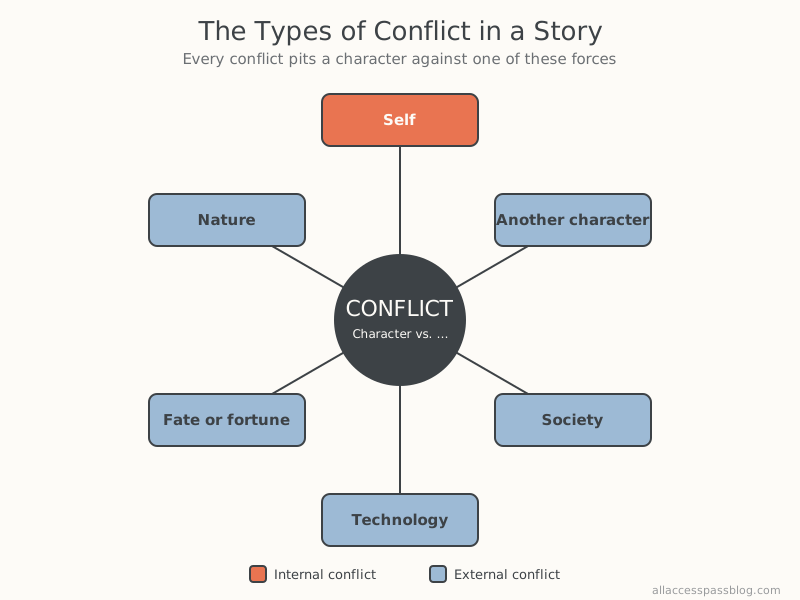
Conflict divides first into two broad kinds. Internal conflict takes place inside a character — a struggle with their own fears, desires, or decisions. External conflict takes place between a character and an outside force. From there, the familiar types follow, each phrased as "character versus" something:
- Character vs. self (internal) — wrestling with one’s own emotions or choices.
- Character vs. character — a clash with another person, often the antagonist.
- Character vs. nature — a struggle against the natural world, as in a survival story.
- Character vs. society — a conflict with the rules, expectations, or injustices of a community.
- Character vs. fate — a struggle against destiny, fortune, or forces beyond human control.
- Character vs. technology — a clash with machines or the consequences of invention.
Rich stories frequently layer more than one type. A character battling a blizzard (vs. nature) may also be fighting their own despair (vs. self) at the same time — and noticing both is a sign of close reading.
It helps students to attach each type to a familiar example. A survival story pits a character against the cold and the wilderness (vs. nature). A courtroom drama or a story about an unjust rule sets a character against the expectations of a community (vs. society). A rivalry between two people — a protagonist and an antagonist — is the most recognizable external conflict of all (vs. character). And the quietest, often most powerful conflict happens entirely inside, when a character must choose between what they want and what they believe is right (vs. self). Asking "who or what is the main character struggling against?" almost always surfaces the central conflict, and asking it twice often surfaces a second.
The conflict wheel
The wheel below gathers the types into one picture, with the single internal type set apart from the external ones.
Embed this infographic (copy and paste the code):
How to summarize: the Somebody-Wanted-But-So-Then method
Once students can name the elements and spot the conflict, summarizing becomes a matter of selecting the few parts that matter most. The most reliable frame for narrative is Somebody-Wanted-But-So-Then (SWBST), because its five prompts map almost perfectly onto the spine of a story:
- Somebody — who is the main character?
- Wanted — what did they want; what was their goal?
- But — what was the conflict, the obstacle in the way?
- So — how did they respond to it?
- Then — what happened in the end?
Strung together, those answers produce a one- or two-sentence summary that captures character, conflict, and resolution while leaving out the clutter. Because the frame forces a choice at every step, it quietly teaches students what to keep — the heart of summarizing. A printable SWBST organizer, along with story maps and other templates, is part of the graphic organizers collection.
The frame scales up, too. For a longer text — a full novel rather than a short story — students can add a final prompt, sometimes written as Somebody-Wanted-But-So-Then-Finally, to capture a larger resolution, or run the frame once per chapter and then summarize the summaries. A class reading S. E. Hinton’s The Outsiders, for instance, can summarize each section with SWBST and then combine those into a single summary of the whole book. The same structure that tames a two-page story also tames two hundred pages, which is exactly why it is worth teaching early and returning to often.
Summary vs. retell
The single most common summarizing mistake is the runaway retell — a play-by-play of every event, "and then… and then… and then." A retell recounts; a summary selects. The difference is judgment about importance:
- A retell aims to include the events in order, often with detail.
- A summary aims to capture only the essentials — the main character, the central conflict, and the outcome — in far fewer words.
A useful test for students: could someone who has never read the story understand what it is about from your summary — without being buried in detail? If yes, it is a summary. If they would need a notepad to keep track, it has drifted into a retell.
Why is this so hard for students? Because leaving things out feels wrong. A reader who has just finished a story remembers vivid moments — a funny line, a small scene — and wants to include them all. Summarizing asks the opposite: it asks the reader to rank the parts by importance and sacrifice the merely memorable for the genuinely central. That is a thinking skill, not a copying skill, which is why a frame like SWBST helps so much — it makes the ranking decisions for the student until they can make those decisions on their own. The goal is not a student who can shorten a text, but a reader who can tell, in any story, which parts carry the weight.
A worked example: “The Gift of the Magi”
O. Henry’s short story “The Gift of the Magi” (1905) is a classic SWBST text — short, beloved, and in the public domain, so you can read it free at Project Gutenberg. Mapped onto the frame:
- Somebody: Della, a young wife with very little money.
- Wanted: to buy her husband Jim a Christmas gift worthy of him.
- But: she had saved only a tiny sum and could not afford one (character vs. circumstance, and an internal pull between pride and love).
- So: she sold her most prized possession — her long, beautiful hair — to buy him a chain for his treasured watch.
- Then: she discovered Jim had sold the watch to buy her combs for the very hair she had cut — a final irony of two people who each sacrificed their best for the other.
Read aloud, the SWBST summary lands in two sentences: Della wanted to give Jim a worthy Christmas gift but had no money, so she sold her hair to buy him a watch chain; then she learned he had sold his watch to buy her hair combs. That is a summary, not a retell — and it captures the story’s theme of loving sacrifice without listing a single minor detail.
Free classic texts to practice on
Summarizing is a skill, and skills need reps. The advantage of teaching with public-domain literature is that every student can have the full text for free. The classic works below are all in the public domain and available to read in full at Project Gutenberg — short, vivid stories and collections that lend themselves to story-element analysis and a quick Somebody-Wanted-But-So-Then summary.
- The Man Who Was Thursday: A Nightmare — Chesterton, G. K. (Gilbert Keith) (1874–1936). Read it free at Project Gutenberg.
- The Works of Edgar Allan Poe — Volume 2 — Poe, Edgar Allan (1809–1849). Read it free at Project Gutenberg.
- The Mysteries of Udolpho — Radcliffe, Ann Ward (1764–1823). Read it free at Project Gutenberg.
- The Cask of Amontillado — Poe, Edgar Allan (1809–1849). Read it free at Project Gutenberg.
- The Gift of the Magi — Henry, O. (1862–1910). Read it free at Project Gutenberg.
Texts and catalogue data via Project Gutenberg (gutendex.com); all titles are in the public domain.
Teaching it in the classroom
The elements, the conflict types, and the summary frame are most powerful when taught as one connected sequence rather than three separate units:
- Name the elements first. Students cannot summarize what they cannot identify. A quick story-elements chart on a familiar text builds the vocabulary.
- Find the conflict. Use the conflict wheel to label the central struggle, and look for layered conflicts in richer texts.
- Model SWBST. Fill in the frame together on a short story, thinking aloud about why each part earns its place.
- Contrast summary and retell. Show a bloated retell beside a tight summary so the difference is unmistakable.
- Release responsibility. Hand students a blank organizer and a new short story, and let them summarize independently.
Taught together, these skills reinforce one another: knowing the elements makes the conflict easy to spot, spotting the conflict makes the summary easy to build, and building summaries sends students back into the text to read more closely the next time. That is the quiet payoff — a summary is not the end of reading but a reason to read well.