Ask a class to name the “types” of characters in a story and the answers tumble out in a jumble: hero, villain, round, flat, sidekick, dynamic. The list is real, but it mixes up categories that answer completely different questions — and that confusion is exactly what trips students up. This guide untangles it. The key idea is that character types are not one long list but a few separate dimensions, and once students learn to ask the right questions in order, classifying any character becomes straightforward.
The two questions that classify a character
The single most useful insight about character types is this: complexity and change are two different things. Many students assume “round” and “dynamic” mean the same thing, and that “flat” and “static” are interchangeable. They are not. They answer two independent questions:
- How complex is the character? — round (many-sided) or flat (one-note).
- Does the character change? — dynamic (transforms) or static (stays the same).
Because the two questions are independent, a character can be any combination of the answers. That is why a richly drawn character can remain exactly the same from start to finish, while a thinly sketched one can still undergo a change. Teaching the two axes separately — and only then combining them — clears up the most common misconception about character analysis in one move.
By complexity: round vs. flat
Round characters
A round character is complex, multidimensional, and often contradictory. The reader sees several sides of them — strengths and flaws, public face and private doubt. Round characters feel like real people because they resist a one-sentence summary. Protagonists are almost always round, since a story needs at least one character rich enough to carry a reader’s attention for its full length.
Flat characters
A flat character is simple and two-dimensional, usually defined by a single dominant trait — the stern teacher, the cheerful neighbor. Flat does not mean badly written; flat characters are efficient. They fill necessary roles without pulling focus from the central figures, and a skilled author uses them deliberately. The distinction is about depth on the page, not about quality.
By change: dynamic vs. static
Dynamic characters
A dynamic character undergoes a meaningful internal change over the course of a story — a shift in personality, values, or understanding. The change has to be genuine and internal: a character who simply ends up richer or in a new city has not necessarily changed, but one who learns humility or finds courage has. This path of change is the character’s arc.
Static characters
A static character is essentially the same person at the end of the story as at the beginning. Static does not mean unimportant — a steady mentor or an unwavering moral center can be central to a story precisely because they do not change. Their constancy often throws the protagonist’s transformation into relief.
Putting the two together
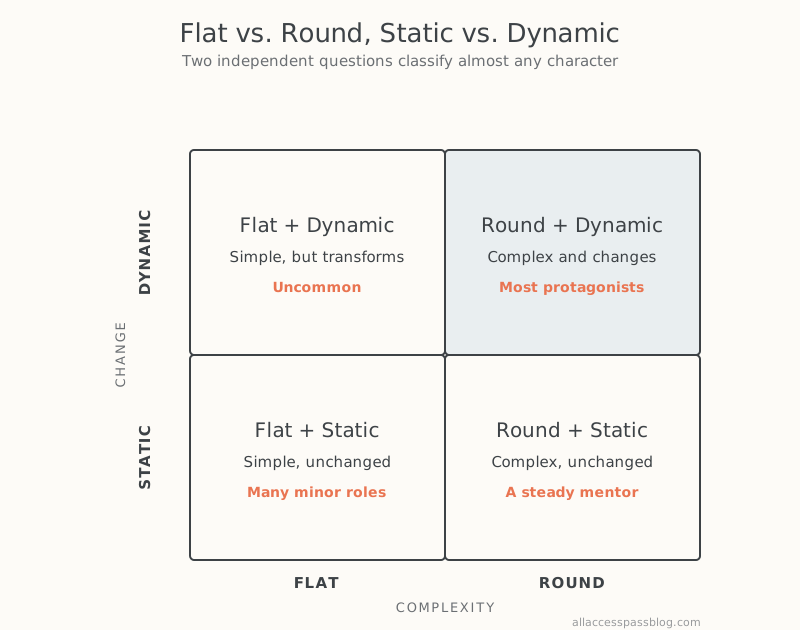
Because complexity and change are independent, every character lands in one of four boxes. The matrix below shows the combinations, with the kind of character you typically find in each.
Embed this infographic (copy and paste the code):
Working through the quadrants is a revealing exercise. Round and dynamic is the home of most protagonists. Round and static holds complex figures who hold their ground — a principled mentor. Flat and static is where most minor characters live, doing their job and moving on. And flat and dynamic — a simple character who nonetheless changes — is the rarest and most interesting to hunt for, because it forces students to separate the two ideas for good.
Common confusions to clear up
A few predictable misconceptions surface every time character types are taught, and naming them directly saves a lot of grief:
- Round does not mean “good,” and flat does not mean “bad writing.” Complexity is a description of depth, not a grade. A well-built story needs flat characters to keep its focus; filling every role with a fully rounded figure would exhaust the reader and blur the central cast.
- Dynamic does not mean “active.” A character can be busy, loud, and central to the action yet never change inside — that makes them static, not dynamic. The question is internal transformation, not how much they do.
- Changing circumstances is not the same as a changing character. Winning a fortune or moving to a new town is a change in situation. A dynamic character changes in who they are — their values, beliefs, or understanding.
- “Protagonist” is not a synonym for “hero,” and “antagonist” is not a synonym for “villain.” These are structural roles. A protagonist can be deeply flawed, and an antagonist can be sympathetic or even an impersonal force.
Clearing these up early means students spend their energy on evidence and argument rather than on untangling the vocabulary.
By role: protagonist, antagonist, foil, and more
A third dimension describes the function a character serves in the plot. These role labels sit alongside complexity and change — a protagonist is also either round or flat, dynamic or static.
- Protagonist. The central character whose goals drive the story and whose perspective the reader usually follows.
- Antagonist. The character or force that opposes the protagonist and generates the central conflict. Not always a villain — it can be a rival, society, or nature.
- Deuteragonist. The second most important character, often a close companion or rival with an arc of their own.
- Foil. A character whose contrasting traits sharpen the reader’s sense of another character, usually the protagonist.
- Confidant. A trusted figure the protagonist confides in, giving the reader a window into the main character’s inner life.
- Stock character. A recognizable conventional type — the wise mentor, the loyal sidekick — usually flat by design.
A useful way to help students assign roles is to start from the conflict rather than the characters. Ask who wants something most and whose wanting drives the plot — that is usually the protagonist. Then ask what stands in the way; the answer points to the antagonist, whether it is a person, a group, or a circumstance. The remaining figures tend to sort themselves: the close ally becomes a deuteragonist or confidant, and a character who exists mainly to contrast with the lead is a foil. Because roles are defined by function, the same character can even shift roles across a long work — a minor figure in early chapters can step into a deuteragonist’s shoes later on.
These roles drive the events on a plot diagram: the protagonist pursues a goal, the antagonist obstructs it, and the tension between them is what climbs toward the climax.
How authors reveal character
Knowing the categories is only half the work; students also need to see how an author builds a character from the text. That process is called characterization, and it comes in two forms.
Direct characterization states a trait outright: “Marco was stubborn.” It is quick and unambiguous. Indirect characterization shows the trait instead, letting readers infer it from evidence. Most memorable characters are built mainly through indirect characterization, because readers trust what they deduce more than what they are told.
A popular classroom tool for gathering that evidence is the STEAL method, which names five kinds of clues: Speech, Thoughts, Effect on others, Actions, and Looks. Students collect quotations and details under each heading and assemble them into a portrait — turning a vague impression into a claim backed by text.
A quick example shows the difference. A writer using direct characterization might write, “Lena was fearless.” Using indirect characterization, the same writer would instead show Lena volunteering first, steadying a frightened friend, and walking toward the noise rather than away from it — and let the reader conclude she is fearless. The second version is harder to write but far more convincing, because the reader has done the inferring. Training students to notice that difference makes them sharper readers and stronger writers at the same time, since they begin to build their own characters through evidence rather than announcement.
Teaching character types
The sequence that works best introduces one dimension at a time and leans on a familiar text:
- One axis at a time. Sort a few known characters as round or flat first. Only once that is solid, sort the same characters as dynamic or static. Combining too early is what causes the classic mix-up.
- Use a two-by-two chart. Have students place characters in the four-box matrix and defend each placement with evidence.
- Gather evidence with an organizer. A STEAL chart or a character map keeps analysis anchored to the text rather than to opinion.
- Move to a full text. A short novel offers a complete cast. A class reading S. E. Hinton’s The Outsiders, for example, can sort Ponyboy, Dally, and Johnny by complexity, change, and role — and discover that the same character can be read more than one way.
- Release responsibility. End with independent analysis of a new character, using the same chart and the same evidence routine.
Taught this way, character analysis stops being a vocabulary quiz and becomes a habit of looking closely. Students who can ask “How complex? Does it change? What role does it play?” have a portable method they can apply to any story they read for the rest of their lives. Best of all, the same three questions work on a picture book and on a thick novel alike, so the method grows with the reader instead of being left behind after a single unit.