Few grammar topics trip students up as predictably as the difference between helping verbs and linking verbs — largely because the very same word can be either one. The word “is” is a helping verb in one sentence and a linking verb in the next. This guide clears up the confusion with plain definitions, a reliable test, and classroom-ready examples.
The quick answer
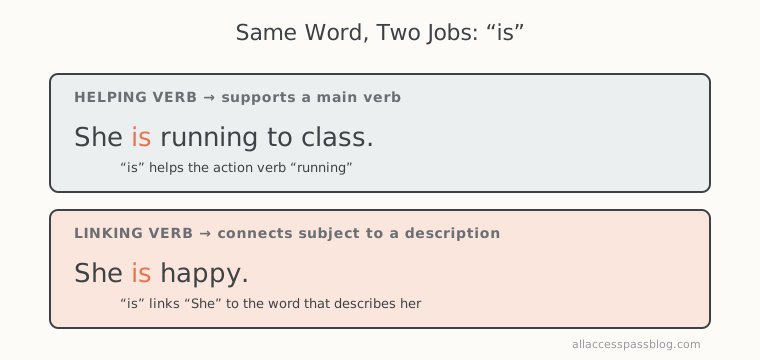
The difference comes down to what the verb is doing in the sentence, not which word it is. A helping verb props up another verb; a linking verb connects the subject to a description. The clearest way to see it is side by side.
What helping verbs do
A helping verb — also called an auxiliary verb — teams up with a main verb to form a complete verb phrase. It carries information about tense, mood, or voice that the main verb alone cannot. In “She is running,” the word “is” helps the main action verb “running.” In “They have finished,” “have” supports “finished.”
The common helping verbs fall into two groups: the primary auxiliaries — forms of be, have, and do — and the modals, such as can, could, will, would, shall, should, may, might, and must. A single verb phrase can stack several: in “She has been studying,” both “has” and “been” are helping verbs, and “studying” is the main verb.
- Forms of be: am, is, are, was, were, be, being, been — used for continuous tenses and the passive voice (“The cake was baked”).
- Forms of have: have, has, had — used for perfect tenses (“They had left”).
- Forms of do: do, does, did — used for questions, negatives, and emphasis (“She does care”).
- Modals: can, could, will, would, shall, should, may, might, must — used to express ability, possibility, permission, or obligation (“You should revise”).
The first three groups are the ones that overlap with linking verbs, because forms of be, have, and do can also stand alone as main or linking verbs. Modals almost never cause confusion, since they are always paired with another verb.
What linking verbs do
A linking verb does not express action at all. Instead, it joins the subject to a subject complement — a noun or adjective that renames or describes the subject. In “She is happy,” the verb “is” links “She” to the adjective “happy” that describes her. In “The soup smells delicious,” “smells” links “soup” to “delicious.”
Besides the forms of “to be,” several sense and state verbs can act as linking verbs: seem, become, appear, feel, look, smell, sound, and taste. The catch is that some of these can also be action verbs — which is exactly where the replacement test earns its keep.
The replacement test
When a verb could be either action or linking, try swapping it for a form of “to be.” If the sentence still makes sense, the verb is linking; if it falls apart, the verb is an action verb.
- “The soup smells delicious” → “The soup is delicious.” Still sensible, so “smells” is a linking verb here.
- “She smells the soup” → “She is the soup.” Nonsense, so “smells” is an action verb here.
The same trick distinguishes a helping “is” from a linking “is”: if a verb follows, it is helping; if a describing word follows, it is linking.
Common mistakes to watch for
- Assuming a word has only one job. The biggest error is deciding that “is” is always a linking verb. The same word changes role from sentence to sentence; only the structure reveals which job it is doing.
- Mislabeling sense verbs. “Look,” “feel,” “taste,” and “smell” are linking verbs only when they connect the subject to a description. When the subject performs the action — “She looked through the telescope” — they are action verbs.
- Forgetting the main verb. In a verb phrase, the helping verb is not the main event. Students sometimes underline only “is” in “She is running” and miss that “running” carries the action.
- Confusing a linking verb with a passive construction. “The window was broken” can be a passive (an action done to the window) or a description (the window’s state). Context — and whether an action is implied — settles it.
None of these require memorizing more rules. Each is solved by the same habit: read what follows the verb, and apply the replacement test when the answer is not obvious.
Teaching the difference
The most effective approach teaches students to look after the verb rather than at it. A short routine works well: underline the verb, ask what follows it, and apply the replacement test when in doubt. Sorting a stack of example sentences into “helping” and “linking” columns — a quick graphic organizer task — turns an abstract rule into a concrete habit. Once students stop memorizing word lists and start reading what comes next, the confusion clears up quickly.
Quick practice
A short set of sentences makes the distinction stick. For each one, students decide whether the bold verb is helping or linking — and explain how they know:
- “The garden looks beautiful.” → Linking: “looks” connects the garden to “beautiful,” and “The garden is beautiful” still makes sense.
- “They are painting the fence.” → Helping: “are” supports the action verb “painting.”
- “The fence is green.” → Linking: “is” connects the fence to the describing word “green.”
- “She has finished her essay.” → Helping: “has” supports the main verb “finished.”
- “The bread smells wonderful.” → Linking: replace with “is,” and the meaning holds.
Working a handful of these aloud, with students naming the test they used, builds the habit far faster than a list of definitions. For more grammar and mechanics resources, browse the grammar topic.