Few ideas in education are as popular — or as misunderstood — as “learning styles.” The notion that each student has a single preferred way of learning has shaped countless lessons and inventories. It is also one of the most thoroughly examined claims in education research, and the findings are not what many teachers expect. This guide explains the framework, summarizes what the evidence actually shows, and offers a more defensible way to put the idea to work.
What “learning styles” means
The learning-styles idea holds that students differ in how they best take in information, and that teaching to each student’s preferred mode will improve their learning. Dozens of models exist, but in most classrooms “learning styles” refers to the VARK framework, developed by Neil Fleming, which sorts learners by sensory modality.
The VARK modalities
VARK names four ways of engaging with material:
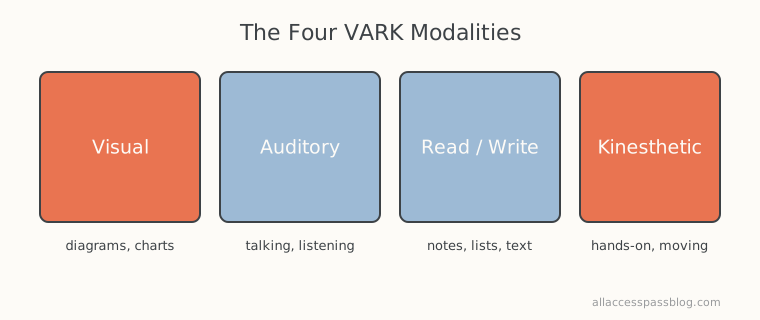
Visual learners are said to favor diagrams and charts; auditory learners, discussion and listening; reading/writing learners, text and notes; and kinesthetic learners, hands-on activity. As a description of preferences, the categories are intuitive and familiar. The trouble begins with the next claim.
What the research actually shows
The testable heart of learning-styles theory is the meshing hypothesis: the claim that matching instruction to a student’s preferred style produces better learning. When researchers have put that claim to the test in controlled studies, they have repeatedly failed to find the predicted benefit. Major reviews of the evidence have concluded that there is no adequate scientific support for designing instruction around fixed learning styles.
The key point is what a fair test requires. To show that styles matter, a study has to teach some students in their preferred mode and others against it, then check whether the matched group actually learns more. Reviews that searched for studies meeting that bar found very few — and the rigorous ones that exist did not show the expected advantage. What does reliably predict how well a lesson lands is not the learner’s “type” but the nature of the material: a process is best shown as a sequence, a map is best seen, a poem is best heard. The most effective mode tends to be dictated by the content, not by a fixed trait of the student.
For that reason, education researchers often classify the strong version of learning styles as a “neuromyth.” This does not mean students are all the same, or that preferences do not exist — only that sorting a student into one style and teaching them only that way is not supported, and may even do harm by discouraging students from strengthening other modes. Being honest about this with students and colleagues is part of teaching well.
Why the idea persists
If the evidence is so thin, why is the belief so widespread? Surveys of teachers across many countries consistently find that a large majority endorse learning styles, and it is easy to see why the idea is so sticky:
- It contains a grain of truth. Students really do have preferences, and material really should be presented in more than one way. The myth piggybacks on a sound instinct.
- It feels respectful. Treating each learner as an individual is a generous impulse, and labeling a student’s style can seem like a way to honor that individuality.
- It is intuitive and memorable. Four tidy categories are far easier to hold onto than the messier reality that good teaching varies by content, not by fixed learner type.
- It is rarely tested in practice. A lesson tailored to “visual learners” that goes well is taken as confirmation, even though the same lesson would likely have helped everyone.
Recognizing why the idea is appealing makes it easier to keep what is useful about it — the push toward variety and individual attention — while letting go of the part the evidence does not support.
A better way to use the idea
The instinct behind learning styles — that information should be presented in more than one way — is a good one. The fix is simply to extend it to every student rather than rationing modes by label:
- Teach multimodally for all. Pair a diagram with an explanation and a hands-on task, so every student gets multiple entry points.
- Use dual coding. Combining words with relevant visuals is well supported by research — which is part of why graphic organizers are so effective.
- Favor evidence-based strategies. Retrieval practice and spaced practice improve learning for everyone, regardless of preference.
- Honor preferences for motivation, not for sorting. Knowing what a student enjoys can boost engagement; it should not be used to limit how they are taught.
A concrete example shows the shift in practice. Suppose a class is studying the structure of a story. A learning-styles approach might send the “visual” students to a diagram, the “auditory” students to a discussion, and the “kinesthetic” students to a sorting activity — splitting the class by label. A multimodal approach instead gives every student all three: they see the plot diagram, talk through it as a class, and physically arrange events on a graphic organizer. No one is restricted to a single channel, and the lesson is richer for everyone. The lesson is also more honest about what is happening: the variety helps because the content is reinforced from several angles, not because it has been matched to fixed types.
Used this way, the familiar VARK vocabulary becomes a prompt to vary instruction rather than a label to pin on a child. For more classroom approaches grounded in what works, browse the classroom strategy topic.