Few novels earn their place in the middle-school classroom as reliably as The Outsiders. S. E. Hinton’s 1967 story of Ponyboy Curtis and the Greasers is short, gripping, and emotionally honest — and it happens to be a near-perfect vehicle for teaching the core skills of literary analysis. This companion offers a teacher’s-eye overview of the novel’s conflict, characters, and themes, along with ideas for building a novel study around it.
A quick overview
Narrated by fourteen-year-old Ponyboy Curtis, The Outsiders unfolds over a tense few days in which a confrontation between two rival groups turns deadly and changes the lives of everyone involved. The novel’s power comes less from its plot than from its voice: Ponyboy’s first-person narration is raw, observant, and unmistakably young, which is why generations of students have seen themselves in it. Because the book is brief and fast-moving, it leaves ample room in a unit for the close reading and analysis that build lasting skills.
Part of the novel’s staying power is the story behind it. S. E. Hinton — the initials famously concealing that the author, Susan Eloise Hinton, was a teenage girl — began writing the book at fifteen, frustrated that the fiction available to her did not reflect the lives of the teenagers she knew. That origin matters in the classroom: students are often startled and energized to learn that one of the most enduring novels assigned to them was written by someone their own age. It reframes the book from a required text into proof that their own observations might be worth writing down.
The story in brief
Without giving away its most affecting turns, the arc is straightforward enough to summarize with the very tools the novel helps teach. Ponyboy, a Greaser, wants simply to get through life with his brothers and friends intact, but a late-night encounter with a group of Socs escalates into violence, so he and his friend Johnny are forced to run and hide, and then a series of consequences — heroism, loss, and hard-won understanding — leaves Ponyboy changed and finally moved to tell the story the reader has just finished. That same Somebody-Wanted-But-So-Then shape, applied chapter by chapter, makes an excellent ongoing reading routine for a class working through the book.
Greasers and Socs: a story divided by class
The novel’s central conflict is a clash between two groups separated by wealth and opportunity. Understanding that divide is the key to understanding everything else in the book.
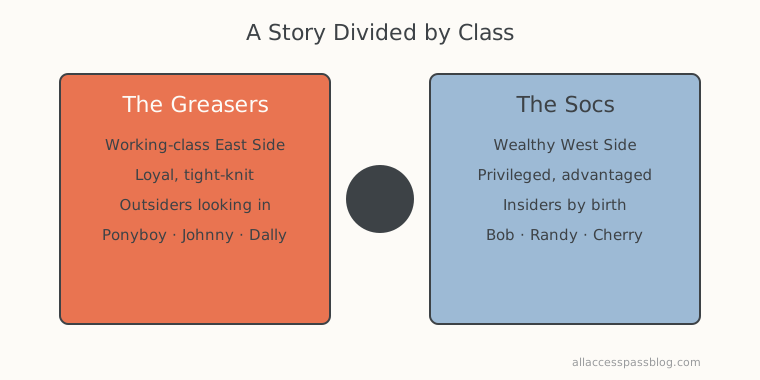
This is a textbook example of character vs. society conflict, layered with character-vs-character clashes between individuals on each side. It is also a useful entry point for a discussion of the types of conflict in literature, since the novel contains internal struggles as well — Ponyboy’s own search for where he belongs.
The main characters
The novel’s cast is one of its greatest teaching assets. A few of the central figures:
- Ponyboy Curtis — the thoughtful, book-loving narrator and protagonist, whose understanding of the world deepens over the novel. He is the clearest example of a dynamic character.
- Johnny Cade — Ponyboy’s gentle, loyal friend, whose arc is among the most affecting in the book.
- Dallas “Dally” Winston — tough and hardened, a complex figure who resists easy judgment.
- Cherry Valance — a Soc who bridges the two worlds and complicates the simple us-versus-them divide.
Because the characters span the full range of character types — dynamic and static, round and flat, protagonists and foils — the novel is an ideal text for practicing character analysis with a character map.
Major themes
Several themes run through the novel and reward classroom discussion. The divide between social classes drives the plot, but the book is just as interested in the bonds of family and friendship that hold the Greasers together in the absence of much else. The loss of innocence shadows the story, crystallized in the Robert Frost poem “Nothing Gold Can Stay,” whose line about the impermanence of what is precious becomes a touchstone for Ponyboy. Tracing how a single image or motif carries a theme across a whole book is exactly the kind of analysis the novel makes possible.
A few threads are especially productive to follow:
- “Things are rough all over.” Cherry Valance’s observation that the Socs have troubles too quietly dismantles the idea that either group has it easy, pushing students past a simple good-versus-bad reading toward genuine empathy.
- Sunsets and shared ground. The recurring image of the sunset — visible from both the East and West sides of town — becomes the novel’s argument that the two groups have more in common than their rivalry admits.
- Telling your own story. The novel’s final turn, in which Ponyboy decides to write down what happened, makes the act of authorship itself a theme — a powerful invitation for students to value their own voices.
Because each theme is carried by concrete, traceable details rather than abstract statements, the book is an ideal place to teach students how writers build meaning beneath the surface of a plot.
Ideas for a novel study
The novel pairs naturally with the core reading skills:
- Map the plot. Chart the rising action, climax, and resolution on a plot diagram as the class reads.
- Analyze the cast. Sort the characters by complexity and change, and identify who serves as a foil to whom.
- Summarize by chapter. Use the Somebody-Wanted-But-So-Then frame on each section, then combine the summaries into one for the whole book.
- Debate the divide. Ask whether the Greasers and Socs are as different as they believe — a question Cherry Valance raises directly.
A handful of discussion questions reliably open the book up. Are the Greasers and Socs really so different, or only divided by circumstance? What does Cherry mean when she says “things are rough all over”? Why does Ponyboy decide, at the end, to write the story down? Each invites students back into the text for evidence rather than toward a tidy right answer.
The novel also lends itself to a culminating writing task. Because it ends with Ponyboy choosing to tell his own story, a natural prompt asks students to write a short personal narrative about a moment that changed how they saw someone — mirroring the book’s own move from judgment to understanding. The assignment ties the reading directly to students’ writing and lands the theme more firmly than any quiz.
Taught this way, The Outsiders becomes more than a beloved story; it becomes the text on which students practice every reading skill they will carry into more demanding literature.